-
23 February 2026Where Autonomous Minibuses Create the Most Value in the U.S.
-
16 February 2026Why Autonomous Minibuses Are the Missing Link in First- and Last-Mile Mobility
-
09 February 2026The First- and Last-Mile Challenge in the U.S.: Why It Still Matters
-
18 November 2025Comprehensive Guide to Electric Bus Programs in the USA: Funding, Incentives & Deployment Strategies

Comprehensive Guide to Electric Bus Programs in the USA: Funding, Incentives & Deployment Strategies
The United States is rapidly advancing toward a zero-emission future for public transportation. With ambitious federal goals to decarbonize transit fleets by 2035, electric bus programs in the USA are expanding across states and municipalities. Supported by multi-billion-dollar federal initiatives and local incentives, transit agencies are accelerating their transition to zero emission buses and sustainable fleet operations.
Federal Funding Programs for Electric and Zero-Emission Buses
Federal funding forms the backbone of the U.S. e-mobility transition. Several major programs now support the purchase, deployment, and planning of electric and low-emission buses across the country.
1. FTA Low-No Emission Vehicle Program
Administered by the Federal Transit Administration (FTA), this flagship program provides competitive grants to help transit agencies purchase or lease zero-emission and low-emission buses, as well as acquire the necessary charging and maintenance infrastructure.
-
Annual Budget (FY2025): $1.1 billion
-
Eligible Applicants: State and local governments, public transportation providers
-
Focus Areas: Bus procurement, charging infrastructure, workforce development
-
Example: The City of Los Angeles recently secured $104 million to expand its all-electric bus fleet through this program.
2. FTA Bus and Bus Facilities Program (49 U.S.C. 5339(b))
This program complements the Low-No initiative by funding the modernization and replacement of buses and maintenance facilities. It ensures that transit agencies can not only procure new zero-emission vehicles but also upgrade the infrastructure that supports them.
-
Annual Budget (FY2025): $390 million
-
Focus Areas: Bus facility upgrades, charging depots, fleet modernization
-
Eligible Applicants: Public transit agencies, state DOTs
-
Example: King County Metro (Seattle) has utilized FTA funding to expand its electric bus depot as part of its goal to achieve a 100% zero-emission fleet by 2035.
3. EPA Clean School Bus Program
This initiative by the U.S. Environmental Protection Agency (EPA) aims to replace aging diesel school buses with zero-emission or clean-energy alternatives. The program combines grants and rebates to promote sustainable student transportation.
-
Total Funding (2022–2026): $5 billion (Infrastructure Investment and Jobs Act)
-
Priority Areas: School districts serving low-income, rural, and tribal communities
-
Recent Update: The 2025 round emphasizes electric bus infrastructure deployment and training.
4. NREL Clean Bus Planning Awards (CBPA)
The National Renewable Energy Laboratory (NREL), under the U.S. Department of Energy, administers technical planning awards rather than direct financial grants. These awards provide expert consulting and modeling tools to help cities plan for zero-emission bus adoption effectively.
-
Award Type: Technical support and fleet transition analysis
-
Focus Areas: Route planning, charging strategy, cost modeling
-
Value: Reduces early-stage barriers for agencies lacking in-house expertise
5. DOE Vehicle Technologies Office (VTO)
The Department of Energy’s Vehicle Technologies Office supports R&D projects, demonstration pilots, and charging infrastructure deployment. It plays a critical role in integrating renewable energy with public transport.
-
Funding Type: Competitive grants and partnerships
-
Focus: Energy efficiency, battery R&D, renewable integration
-
Collaborators: Universities, private manufacturers, local transit authorities
|
Program |
Administrator |
Focus |
Funding Type |
Eligible Applicants |
|
FTA Low-No |
FTA |
Zero-emission bus purchase |
Grant |
Transit agencies |
|
FTA Bus & Bus Facilities |
FTA |
Depot modernization & fleet upgrades |
Grant |
Transit agencies |
|
EPA Clean School Bus |
EPA |
School bus electrification |
Grant/Rebate |
School districts |
|
NREL Clean Bus Planning Awards |
NREL |
Planning & technical assistance |
Award |
Transit agencies |
|
DOE VTO |
DOE |
R&D and infrastructure |
Grant |
State & local partners |
State-Level Incentives and Local Support Programs
Beyond federal initiatives, many U.S. states offer supplemental funding for zero emission buses.
Leading programs include:
-
California (CARB HVIP & LCFS Credits): Provides up to $120,000 per bus for electric fleet adoption.
-
New York (NYSERDA Program): Grants covering up to 80% of vehicle costs.
-
Texas (TERP): Offers emissions reduction incentives for municipal and regional fleets.
-
Washington – Green Transportation Capital Grant Program: Funds zero-emission fleet conversion and charging infrastructure projects across the state.
These state-level incentives often complement federal grants, enabling transit agencies to leverage multiple funding sources for faster fleet modernization.
Deployment Trends and Fleet Electrification Insights
The adoption of zero-emission buses in the USA has accelerated sharply since 2020.
Cities like Seattle, New York, and Denver have made major commitments to fully electrify their fleets within the next decade.
Key trends include:
-
Integration of Renewable Energy: Transit agencies increasingly link depot charging to solar or wind power.
-
Mid-size Fleet Growth: Demand for compact electric buses is rising in suburban and small-city networks.
-
Data-Driven Planning: Software and AI-based tools guide energy-efficient route management.
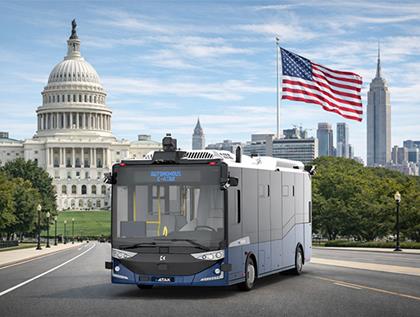
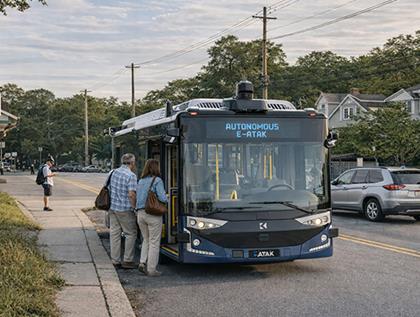
These dynamics position Karsan’s mid-size electric buses, such as e-JEST, Autonomous e-JEST and Autonomous e-ATAK, as highly relevant for the U.S. market—offering proven efficiency, flexibility, and technology readiness.
Karsan: Bringing European Leadership to U.S. Fleet Electrification
With electric bus deployments across in three continents, Karsan has proven that urban mobility can be both sustainable and efficient.
Our e-JEST, e-ATAK, and e-ATA Hydrogen models combine intelligent design with energy efficiency, helping cities reduce emissions and operating costs.
“Karsan’s expertise in zero-emission fleet deployment aligns perfectly with America’s transition to cleaner, smarter transit systems.”
By leveraging lessons from European success stories, Karsan stands ready to support American transit agencies as they plan, fund, and implement the next wave of electric bus programs in the USA.