-
23 February 2026Where Autonomous Minibuses Create the Most Value in the U.S.
-
16 February 2026Why Autonomous Minibuses Are the Missing Link in First- and Last-Mile Mobility
-
09 February 2026The First- and Last-Mile Challenge in the U.S.: Why It Still Matters
-
18 November 2025Comprehensive Guide to Electric Bus Programs in the USA: Funding, Incentives & Deployment Strategies
The United States boasts some of the most extensive rail and rapid transit networks in the world. Yet, ridership numbers often struggle to meet capacity. The greatest structural obstacle facing U.S. public transportation systems today is not necessarily the speed of the main lines or the quality of the trains. The real barrier is the difficulty passengers face just trying to get to them.
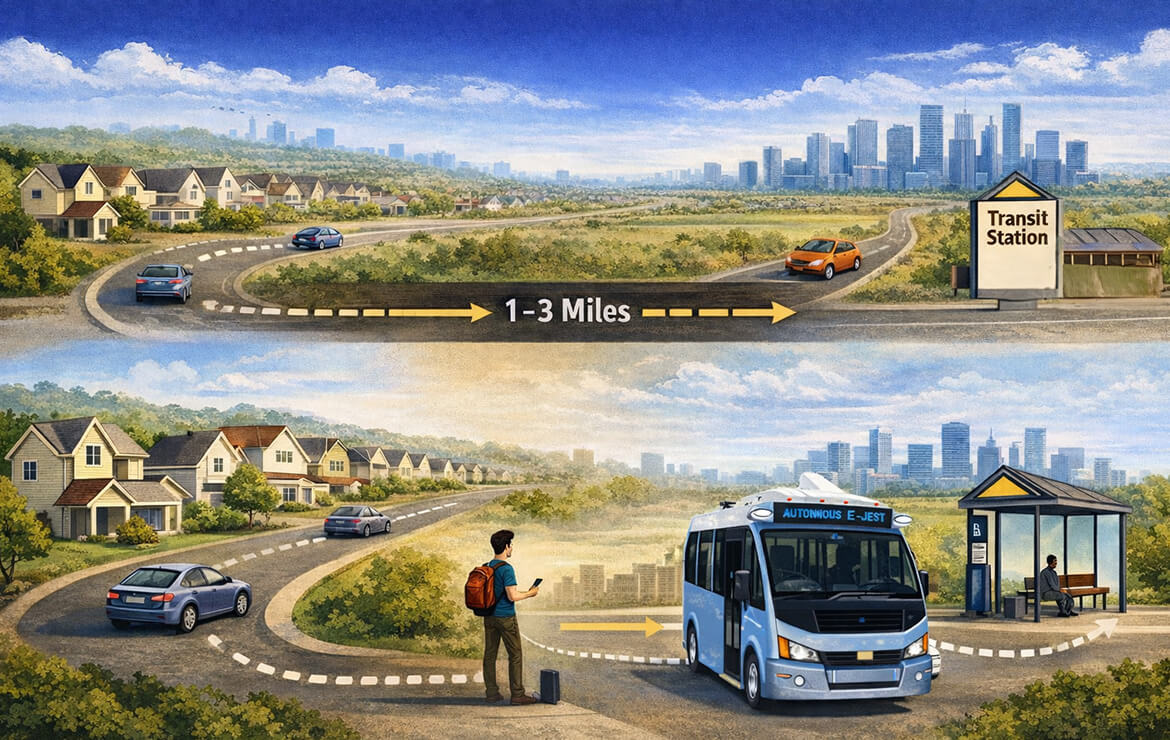
This creates a paradox: A commuter might live just two miles from a high-speed train station that connects directly to the city center. However, if those two miles are not walkable and lack reliable feeder service, the high-speed train becomes irrelevant. The commuter drives to work instead.
This is the First- and Last-Mile (FLM) challenge. It is a persistent gap in the American mobility landscape that limits the efficiency of entire transit networks. To solve it, we must first understand why traditional approaches are failing and why the solution lies in a new class of right-sized mobility.
What Is First- and Last-Mile Transportation?
In the context of public transit, the "First and Last Mile" refers to the distance a passenger must travel from their origin (home) to the nearest transit node (bus stop or train station), and from the transit node to their final destination (office, campus, or store).
In dense European cities, this distance is often a walkable 400 to 800 meters. In the United States, however, the definition of this "mile" is vastly different. Due to zoning laws and infrastructure design, the distance to the nearest transit hub is often 2 to 3 miles. This distance is too long to walk, especially in inclement weather or areas lacking sidewalks, yet too short to justify a complex car trip if an alternative existed.
When this critical connection is missing, the entire transit ecosystem suffers. The "First Mile" becomes the bottleneck that prevents potential riders from entering the system in the first place.
The Impact of Urban Sprawl and Car Dependency
The root cause of the FLM challenge in the U.S. is unique: Urban Sprawl. unlike vertical cities, American urban planning has historically favored horizontal expansion. This has resulted in vast suburbs, cul-de-sacs, and low-density residential areas that spread populations over wide geographic areas.
This dispersed structure makes "standard" public transport difficult to implement.
-
Density Issues: Traditional 40-foot (12-meter) buses require high passenger density to be efficient. In sprawling suburbs, these large buses often run empty, leading to high operating costs per passenger.
-
The Car Necessity: Because public transit cannot efficiently penetrate these low-density neighborhoods with large vehicles, residents are forced into "car dependency."
The result is a vicious cycle: Transit agencies reduce service in suburbs due to low ridership, and ridership drops further because service is infrequent.
Gaps in Accessibility and Connectivity
The core of the problem is a Connectivity Gap. A transit network is only as strong as its weakest link. You can have a world-class metro system, but if the "feeder" network—the capillary veins that bring people to the arteries—is broken, the system fails to reach its potential.
This gap creates inefficiencies:
-
Underutilized Assets: Main transit lines run below capacity because people cannot access them easily.
-
Parking Congestion: Commuters who drive to train stations fill up "Park-and-Ride" lots early in the morning, physically capping the number of people who can use the train.
-
Inequity: Those who cannot drive (the elderly, students, or those without cars) are left stranded in transit deserts.
The Need for New Mobility Approaches
For decades, the standard solution to the FLM problem was the "Hub-and-Spoke" model, attempting to force large, diesel buses into low-density neighborhoods. This approach is no longer sustainable financially or environmentally. The solution requires a shift from "capacity" to "agility."
We need vehicles that are designed for the reality of American suburbs—vehicles that are right-sized, electric, and flexible.
The Role of Compact and Agile Vehicles
To close the accessibility gap, transit agencies are turning to compact electric buses like the Karsan e-JEST. Unlike a massive city bus, the 230-inches e-JEST can navigate narrow residential streets, cul-de-sacs, and tight drop-off zones with ease. It offers the dignity and comfort of a full bus service but at a scale that makes sense for the First and Last Mile. By deploying these agile vehicles, operators can increase frequency and coverage without the high cost of running empty 40-foot buses.
The Future of Feeder Routes: Automation
Furthermore, the driver shortage crisis in the U.S. is forcing agencies to rethink how they staff these feeder routes. This is where innovation meets necessity. Level 4 Autonomous technology, found in the Karsan Autonomous e-ATAK and and Autonomous e-JEST offer a way to maintain consistent, 24/7 feeder services in business parks, campuses, and residential loops without being constrained by driver availability.
Conclusion: Closing the Gap
The First- and Last-Mile challenge is not just a logistics problem; it is the key to unlocking the full potential of public transportation in the United States. By acknowledging that the "one-size-fits-all" approach of large buses does not work for American sprawl, we can embrace a new era of connectivity.
The future of U.S. transit lies in filling these gaps with intelligent, right-sized, and zero-emission solutions that meet passengers where they live.