-
23 February 2023Karsan Hydrogen Fuel Cell Bus e-ATA Hydrogen
-
17 July 2024Small City Buses: The Eco-Friendly Choice for Urban Commutes
-
23 September 2024Different Bus Sizes in Urban Transportation
-
02 October 2024What is a Shuttle Bus? How is it Used in Urban Transportation?
-
21 September 2026What Is Transit-Oriented Development (TOD)?
-
14 September 2026What Makes a Bus Truly Autonomous? The Sensors and Systems Behind Karsan's e-JEST
-
07 September 2026Measuring Sustainability in Public Transport: Which KPIs Matter Most?
-
28 August 2026Karsan × Toyota: Building the Hydrogen Bus of the Future
In our previous post, we identified the "First- and Last-Mile" challenge as the single greatest barrier to efficient public transit in the United States. We established that the gap between a passenger's home and the nearest transit hub is often too far to walk, yet traditional transit solutions struggle to bridge it effectively.
If the problem is a "Connectivity Gap," then the solution must be a vehicle designed specifically to close it. It requires a mode of transport that is more agile than a city bus, more efficient than a private car, and more reliable than a shuttle dependent on a fluctuating labor market.
This is where Autonomous Minibuses and Minibuses enter the equation. They represent the "Missing Link" in modern mobility—a technological leap that transforms the First and Last Mile from a logistical headache into a seamless, efficient, and sustainable service.
Limits of Traditional Fixed-Route and Shuttle Services
To understand the value of autonomous technology, we must first look at why the current model is failing in suburban and low-density areas.
For decades, transit agencies have tried to serve these areas using standard 40-foot (12-meter) diesel buses running on fixed schedules. This approach creates an "Efficiency Gap."
-
The "Ghost Bus" Phenomenon: Running a massive vehicle capable of carrying 80 people through a neighborhood to pick up only three passengers is financially unsustainable. It wastes fuel, increases wear and tear on infrastructure, and drains the agency’s budget.
-
Rigidity: Fixed routes cannot adapt to the scattered nature of suburban sprawl. If the bus doesn’t pass the specific street where a commuter lives, that commuter will likely drive.
What Makes Autonomous Minibuses Different? (The Right-Sized Advantage)
The solution is not to stop serving these areas, but to serve them with the Right-Sized vehicle.
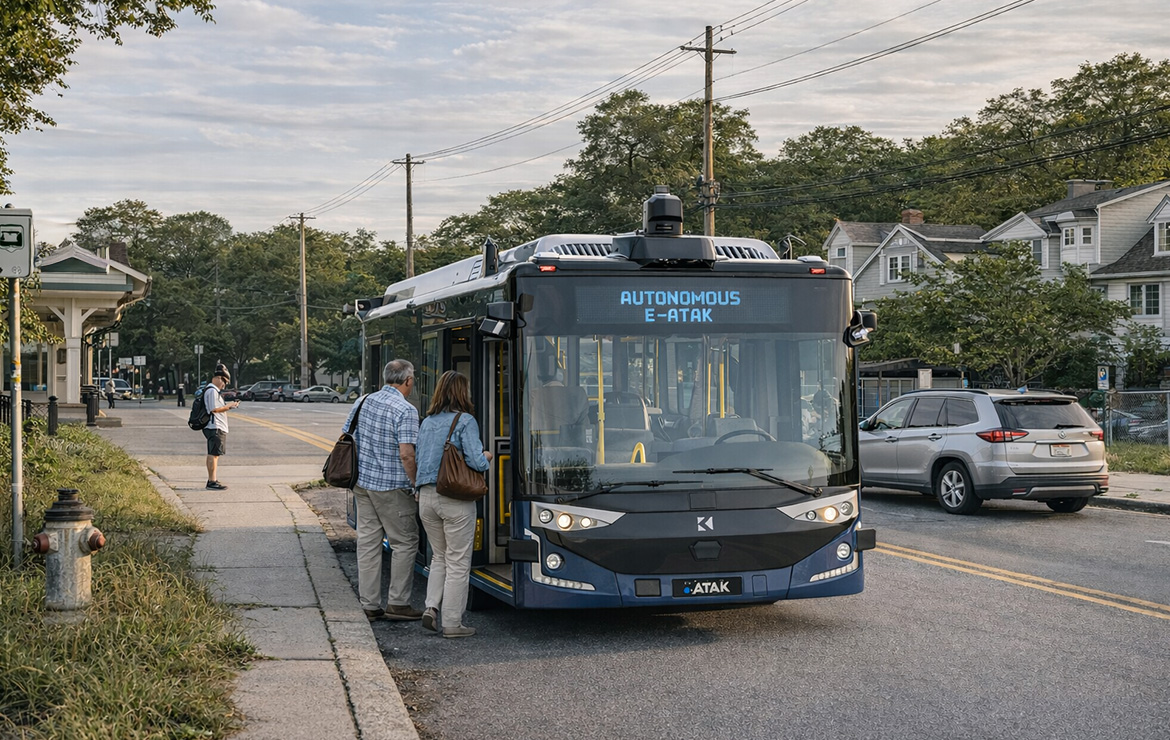
Autonomous buses, such as the Karsan Autonomous e-ATAK and Autonomous e-JEST, are purpose-built for this niche. With lengths of 8,315 mm (approx. 26 feet) for the Autonomous e-ATAK and 5,845 mm (approx. 19 feet) for the Autonomous e-JEST, both models offer a compact footprint that enables them to easily navigate narrow residential streets, cul-de-sacs, and tight drop-off zones that are typically inaccessible to larger buses.
By matching the vehicle size to the actual demand, operators can drastically reduce the cost per mile. This "Right-Sized" approach allows agencies to penetrate deeper into neighborhoods, picking passengers up closer to their front doors and delivering them directly to the main transit line.
Flexible, On-Demand, and Agile Operations
The true power of autonomous technology lies in its digital DNA. Unlike traditional buses that are tethered to rigid timetables, autonomous minibuses are designed for On-Demand Agility.
Level 4 autonomous systems can integrate seamlessly with Demand-Responsive Transport (DRT) software. This transforms the service from a static "bus route" into a dynamic "mobility cloud."
-
Dynamic Routing: Instead of driving in an empty loop, the vehicle can adjust its path in real-time based on ride requests.
-
Reduced Wait Times: By optimizing routes instantly, the system reduces the time passengers spend waiting at the curb, making public transit a competitive alternative to ride-hailing apps.
Improving Safety and Service Reliability Through Automation
One of the most critical challenges facing U.S. transit agencies today is the severe Driver Shortage. Routes are being cut simply because there are not enough qualified drivers to staff them.
Autonomous minibuses offer a solution to this crisis by ensuring Service Continuity.
-
24/7 Availability: An autonomous system does not have shift limits. It can operate late at night or early in the morning, ensuring that First- and Last-Mile connections are always available, even during off-peak hours.
-
Standardized Safety: Human error accounts for the vast majority of traffic accidents. The Karsan Autonomous e-ATAK utilizes LiDAR, radar, and thermal cameras to perceive its environment with 360-degree precision. It never gets tired, distracted, or stressed, providing a standardized level of safety that builds passenger trust.
Seamless Integration with Existing Transit Networks
It is important to clarify that autonomous minibuses are not here to replace the metro, light rail, or high-capacity BRT lines. They are here to feed them.
They act as the Connector. In a healthy transit ecosystem, the heavy rail lines are the arteries, and the autonomous minibuses are the capillaries. They collect passengers from low-density areas and aggregate them at high-speed hubs.
By solving the inconvenience of the first mile, these vehicles increase ridership on the entire network. They ensure that the massive investments made in main transit lines pay off by making those lines accessible to everyone, regardless of how far they live from the station.
Conclusion: The Bridge to the Future
Autonomous minibuses are no longer a science fiction concept; they are a commercially available reality solving real-world problems today. By adopting right-sized, autonomous, and electric solutions, U.S. municipalities can close the efficiency gap, solve the driver shortage, and finally fix the First- and Last-Mile problem.