-
23 February 2023Karsan Hydrogen Fuel Cell Bus e-ATA Hydrogen
-
17 July 2024Small City Buses: The Eco-Friendly Choice for Urban Commutes
-
23 September 2024Different Bus Sizes in Urban Transportation
-
02 October 2024What is a Shuttle Bus? How is it Used in Urban Transportation?
-
21 September 2026What Is Transit-Oriented Development (TOD)?
-
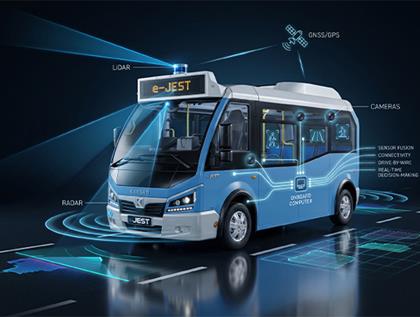
14 September 2026What Makes a Bus Truly Autonomous? The Sensors and Systems Behind Karsan's e-JEST
-
07 September 2026Measuring Sustainability in Public Transport: Which KPIs Matter Most?
-
28 August 2026Karsan × Toyota: Building the Hydrogen Bus of the Future

Climate Policies Driving EV Bus Adoption in Europe and the Middle East
Electric buses are fast becoming the cornerstone of sustainable mobility strategies worldwide. Policies designed to cut greenhouse gas emissions, improve urban air quality, and meet net-zero targets are driving governments and operators to replace diesel fleets with battery-electric and, in some cases, hydrogen-powered buses. Europe and the Middle East, despite very different policy contexts, are both making bold moves to electrify their public transport systems.
Global Market Momentum
According to the International Energy Agency (IEA, 2023), global EV sales are reaching record highs:
-
10 million EVs were sold worldwide in 2022, with projections of 14 million in 2023 (a 35% jump).
-
EVs have expanded from 4% of global sales in 2020 to an expected 18% in 2023.
-
Europe accounts for 25% of global EV sales and 30% of the global EV stock, making it the second-largest market after China.
This momentum is setting the stage for faster EV bus adoption, backed by targeted climate policies.
Europe: Leading with Regulation and Targets
Europe has paired climate ambition with concrete regulations that push cities and operators toward zero-emission fleets:
-
European Green Deal and Fit for 55: Commit to cutting emissions by 55% by 2030 and achieving climate neutrality by 2050.
-
EU Clean Vehicles Directive: Requires public procurement to include minimum shares of clean buses — often meaning more than half of new buses purchased must be zero-emission.
-
IEA Projections: EV sales share in Europe is expected to grow from 10% in 2020 to 58% in 2030 under the STEPS scenario, and up to 64% in the Announced Pledges Scenario (APS).
National governments are backing this with direct support:
-
Germany: Federal funding covers up to 80% of the price difference between electric and diesel buses, alongside infrastructure investment.
-
France & Netherlands: Aggressive zero-emission fleet targets for major cities.
-
Nordics: Oslo and Amsterdam are phasing out diesel buses entirely by the early 2030s.
Impact: By 2030, EVs are set to dominate Europe’s bus procurement market, transforming both city transport and intercity networks.
Middle East: Mega-Projects and National Visions
In the Middle East, climate policy is closely tied to national economic diversification strategies and high-profile international commitments:
-
UAE Net Zero 2050: Dubai’s RTA has begun piloting EV and hydrogen buses as part of its clean mobility roadmap.
-
Saudi Arabia Vision 2030: Riyadh’s BRT system is introducing electric buses to reduce oil dependence and cut urban emissions.
-
Qatar National Vision 2030: Mandated that 25% of its bus fleet be electric by 2022, a target achieved ahead of the FIFA World Cup, with ongoing expansion of charging depots in Doha.
-
Israel: Linking air quality targets with incentives for EV buses in cities like Tel Aviv and Haifa.
While absolute numbers remain smaller than in Europe, the region’s growth rate is among the world’s fastest, driven by ambitious climate-linked megaprojects and showcase events.
Challenges: Batteries, Materials, and Lifecycle Impacts
The shift to electric buses also raises sustainability questions:
-
Battery demand: Growing EV fleets require more lithium, cobalt, and nickel. Extraction and processing carry emissions that can undermine decarbonization goals.
-
Lifecycle emissions: An ICCT (2021) study found that only Battery Electric Vehicles (BEVs) and Fuel Cell Electric Vehicles (FCEVs) deliver substantial life-cycle GHG reductions compared to diesel, with BEVs offering clear advantages even on average grid electricity.
-
End-of-life management: Without robust recycling and reuse strategies, battery waste could become a significant challenge.
Solutions are emerging: the EU’s new Battery Regulation (2023) mandates recycling targets, while circular economy approaches are exploring second-life applications for bus batteries in stationary storage.
Global Initiatives Supporting EV Adoption
Several intergovernmental initiatives are catalyzing EV deployment worldwide, offering frameworks that Europe and the Middle East can leverage:
-
Accelerating to Zero (A2Z) Coalition: Launched at COP27, unites 200+ governments, businesses, and investors around faster EV adoption.
-
AVERE (Europe): Advocates for a 2030 ICE phase-out, stronger CO₂ targets, and dense charging networks, including infrastructure suitable for buses and heavy-duty vehicles.
-
IEA Electric Vehicles Initiative (EVI): With 16 member countries, it promotes campaigns like EV30@30 (30% new EV sales by 2030), the Zero-Emission Government Fleet Declaration, and the Global EV Pilot City Programme.
-
UNEP Global Electric Mobility Programme: Supports 50+ low- and middle-income countries with policy advice, investment platforms, and tools like the eMob calculators.
These initiatives highlight the importance of global collaboration in scaling EV adoption, ensuring policy alignment, and sharing best practices.
Climate Policy as the Accelerator
Both Europe and the Middle East demonstrate that policy is the decisive factor in EV bus adoption.
-
In Europe, binding regulations, emissions targets, and procurement rules are driving the market toward zero-emission fleets.
-
In the Middle East, national visions, climate pledges, and global events are pushing governments to electrify fleets at speed.
Despite challenges around batteries, lifecycle emissions, and infrastructure readiness, the trajectory is clear: electric buses are no longer a fringe solution, but a central pillar of climate and mobility policy.
The road to sustainable public transport runs through policy-backed electrification — and both regions are proving how ambitious commitments can transform entire bus fleets within a decade.