-
23 February 2023Karsan Hydrogen Fuel Cell Bus e-ATA Hydrogen
-
17 July 2024Small City Buses: The Eco-Friendly Choice for Urban Commutes
-
23 September 2024Different Bus Sizes in Urban Transportation
-
02 October 2024What is a Shuttle Bus? How is it Used in Urban Transportation?
-
21 September 2026What Is Transit-Oriented Development (TOD)?
-
14 September 2026What Makes a Bus Truly Autonomous? The Sensors and Systems Behind Karsan's e-JEST
-
07 September 2026Measuring Sustainability in Public Transport: Which KPIs Matter Most?
-
28 August 2026Karsan × Toyota: Building the Hydrogen Bus of the Future
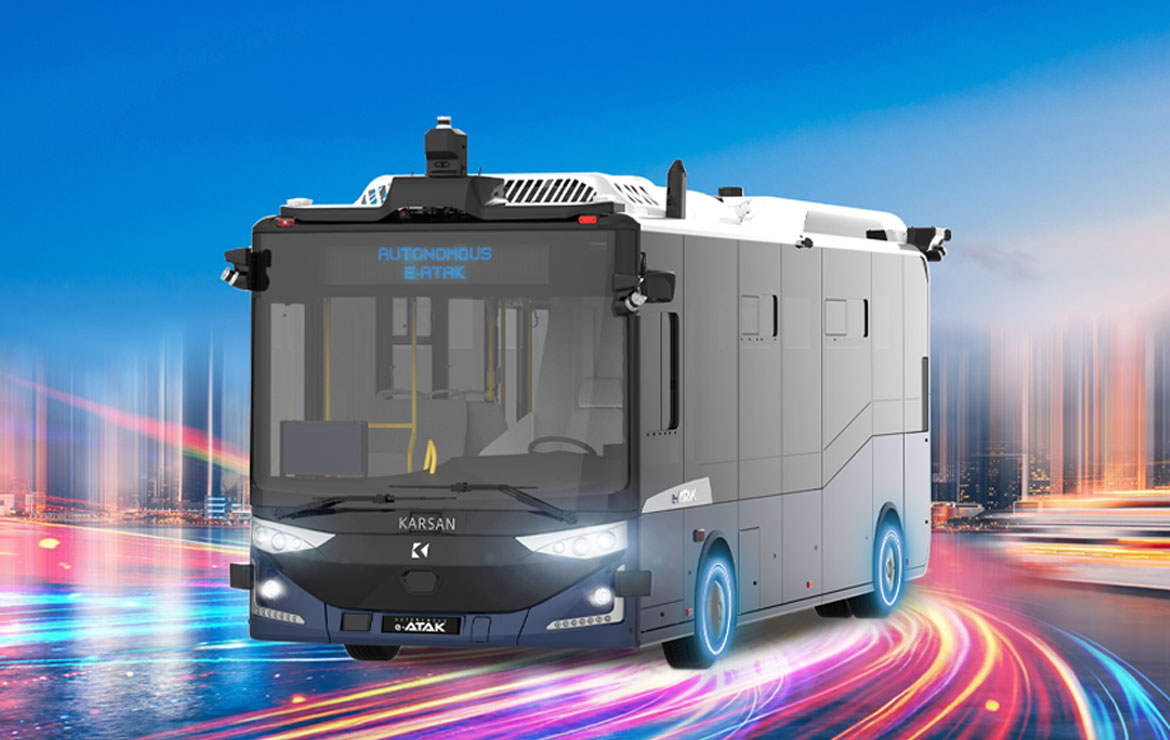
Transformative Change: Efficient Autonomous Public Transportation
Autonomous transportation is no longer a futuristic concept; it is actively reshaping public mobility today. At the forefront of this shift is Karsan’s Autonomous e-ATAK, integrating advanced autonomous driving systems within a proven electric bus platform.
Its Level-4 autonomous capability enables the bus to operate safely in real traffic environments without a driver. The Autonomous e-ATAK interprets complex urban scenarios, senses its full surroundings, and performs precise maneuvers including autonomous stopping and intersection navigation.
From Concept to Real Financial Results
Autonomy isn’t just a technological milestone — it’s an economic one.
By removing the need for a human operator, transit agencies reduce their largest operational cost category: labor. Additionally, autonomous driving smooths acceleration and braking, resulting in lower energy usage and longer component life.
Pilot programs in Europe and North America report 10–15% energy savings compared to manually driven electric buses.
Increased Safety, Precision, and Passenger Comfort
LiDAR, radar, high-definition cameras, and AI-driven decision-making combine to provide 360° situational awareness around the Autonomous e-ATA. The result:
-
Immediate detection of pedestrians, cyclists, and vehicles
-
More consistent braking
-
Optimized speed control
-
Enhanced passenger comfort
For operators, this dramatically reduces human error, establishing a new benchmark for public transport safety.
Karsan's Competitive Advantage: Implementing Autonomy at Large-Scale
While many manufacturers are still testing prototypes, Karsan has already deployed autonomous buses in real-world traffic:
-
Stavanger, Norway
-
Michigan, United States
These deployments prove the Autonomous e-ATAK is beyond demonstration-phase technology — it is commercially viable today.
Its autonomous system dynamically adapts to environmental differences, including snow, low-light conditions, and dense urban corridors, continually improving through cloud-based AI updates.
Reimagining Public Transportation Efficiency
Public transit has always centered on three principles:
low cost, high uptime, and consistent service.
The Autonomous e-ATAK elevates each of these pillars:
-
Predictive maintenance minimizes downtime
-
Telematics optimize routes
-
Smart energy balancing enhances range and stability
Autonomy isn't merely “removing the driver.”
It’s building a more efficient system.
The Autonomous e-ATAK shows how cities can achieve cleaner, safer, and more efficient public transport today — not in a distant future.
Frequently Asked Questions (FAQ)
1. What is the autonomous level of the e-ATAK?
The Autonomous e-ATAK uses Level-4 autonomous technology, enabling fully autonomous operation on defined routes and controlled environments.
2. Is the Autonomous e-ATAK currently being used?
Yes. It is already in service in Europe and North America — marking the first real-world deployment of a self-driving electric bus operating in mixed traffic.
3. How will the Autonomous e-ATAK improve efficiency?
By optimizing route planning, reducing idle time, and eliminating driver labor dependency, the Autonomous e-ATAK reduces operating costs and increases fleet uptime.
4. What technologies enable the Autonomous e-ATAK to be safe?
Safety is ensured through a fusion of LiDAR, radar, cameras, GPS, and AI decision algorithms, creating complete situational awareness and executing safe autonomous maneuvers.
5. Can autonomous buses operate under different weather and road conditions?
Yes. The Autonomous e-ATAK’s AI model continuously adapts to local climate conditions — such as snow, rain, glare, or dense traffic — supported by real-time cloud-based updates.
💡 As Karsan continues to pioneer in autonomous transportation, the big question becomes:
If buses are already able to travel autonomously with such efficiency, what’s next for the future of mobility?