-
23 February 2023Karsan Hydrogen Fuel Cell Bus e-ATA Hydrogen
-
17 July 2024Small City Buses: The Eco-Friendly Choice for Urban Commutes
-
23 September 2024Different Bus Sizes in Urban Transportation
-
02 October 2024What is a Shuttle Bus? How is it Used in Urban Transportation?
-
21 September 2026What Is Transit-Oriented Development (TOD)?
-
14 September 2026What Makes a Bus Truly Autonomous? The Sensors and Systems Behind Karsan's e-JEST
-
07 September 2026Measuring Sustainability in Public Transport: Which KPIs Matter Most?
-
28 August 2026Karsan × Toyota: Building the Hydrogen Bus of the Future
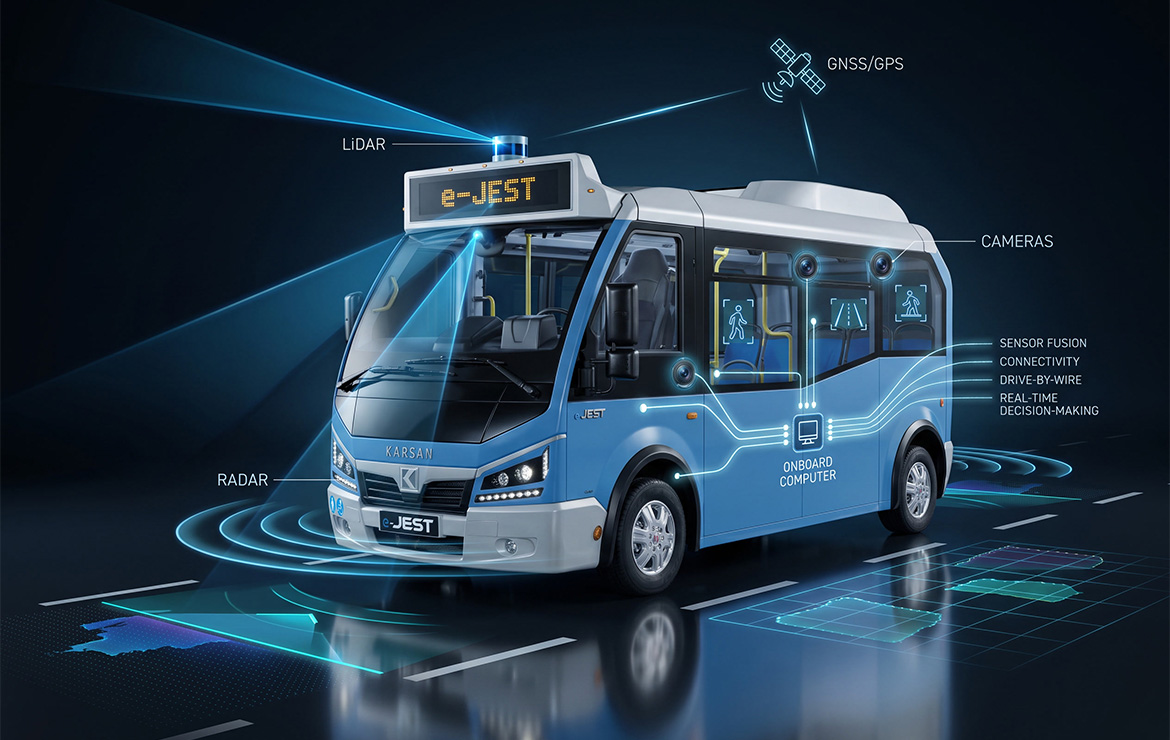
Transitioning public transit from driver-assist technologies to true driverless operation requires more than pre-programmed GPS coordinates. An autonomous bus navigating dense urban corridors must perceive its surrounding environment in three dimensions, detect moving obstacles under severe weather conditions, and execute instant path-planning decisions without human intervention.
While high-level market analyses frequently examine global autonomy trends, understanding true self-driving capability requires a technical deep dive into vehicle hardware. At the core of Karsan’s Autonomous e-JEST is a multi-layered sensor suite, drive-by-wire actuation, and high-performance artificial intelligence. Examining how these onboard components operate in unison reveals the complex engineering that powers true driverless transit.
The Tri-Sensor Array: LiDAR, Radar, and High-Resolution Vision
No single sensing modality is sufficient for safe Level 4 autonomous driving. Optical cameras struggle with dense fog or direct sunlight glares, radar lacks high-resolution object classification, and LiDAR performance can degrade in heavy snowfall. To achieve absolute environmental awareness, the Autonomous e-JEST utilizes a redundant, tri-sensor perception layout:
-
Solid-State and Rotational LiDAR: Positioned strategically around the perimeter of the electric minibus, high-definition LiDAR sensors emit millions of laser pulses per second. By measuring the time-of-flight (ToF) of reflected beams, the system generates a dense 3D point cloud map of the vehicle's surroundings up to 200 meters away, identifying precise spatial boundaries and object dimensions down to the millimeter.
-
Millimeter-Wave (mmWave) Radar Units: Long-range and short-range radar modules provide continuous velocity tracking and distance detection. Because radar signals penetrate adverse weather, these sensors maintain object tracking during heavy rain, snow, and dense urban smog, ensuring reliable emergency braking triggers regardless of optical visibility.
-
High-Dynamic-Range (HDR) Optical Cameras: A surrounding network of high-resolution cameras captures full 360-degree visual data. Computer vision algorithms process these camera feeds in real time to read traffic signals, interpret dynamic road signs, recognize pedestrian gestures, and identify lane markings across complex intersections.
Sensor Fusion and AI Decision-Making Architecture
Gathering raw sensor telemetry is only the first phase of autonomous navigation. The critical engineering challenge lies in processing thousands of independent data points simultaneously without introducing computational latency.
The Autonomous e-JEST leverages advanced Sensor Fusion software powered by high-throughput edge AI processors:
-
Perception Alignment & Data Synchronization: The central AI unit ingests disparate data streams combining LiDAR point clouds, radar velocity vectors, and camera pixel matrices into a single, unified 3D environmental map. Sensor fusion eliminates individual sensor blind spots and resolves false-positive detections.
-
Object Classification & Predictive Tracking: Deep neural networks classify every detected object (e.g., pedestrians, cyclists, passenger cars, urban debris) and predict their motion trajectories up to several seconds into the future.
-
Path Planning & Drive-by-Wire Actuation: Once a safe trajectory is calculated, the motion planning module sends digital commands to the vehicle's electronic control units (ECUs). Drive-by-wire systems immediately translate these digital signals into precise mechanical actions adjusting steering angle, applying regenerative or hydraulic braking, and modulating electric drive torque without mechanical lag.
Understanding how this complete sensor-to-actuation pipeline operates highlights the strict technical boundaries that separate driver-assist platforms from fully self-driving architectures. Transit managers evaluating hardware compliance can explore foundational operational thresholds in Level 4 vs Other Autonomy Levels: What Sets It Apart?
First-Hand Deployment: The Atlanta Level 4 Operation and CES 2026 AI Evolution
Proving autonomous reliability requires shifting from closed proving grounds to active, complex urban environments. Karsan has demonstrated the real-world maturity of its self-driving technology through landmark North American operations and next-generation software launches:
-
Active Level 4 Operations in Atlanta (ATL Spoke Project): In collaboration with technology partner ADASTEC, North American distributor Damera, and service orchestration partner Beep, a fleet of Autonomous e-JEST vehicles operates in Atlanta, Georgia. Serving the ATL Spoke pilot project between MARTA West End Station and the Atlanta BeltLine, the zero-emission minibus executes fully autonomous 7-day-a-week passenger routes in mixed traffic. Having completed rigorous U.S. Department of Transportation Altoona durability evaluations alongside FMVSS, CMVSS, and ADA compliance, the vehicle proves its Level 4 operational maturity in demanding urban corridors.
-
CES 2026 Karsan AI Architecture Unveiling: At the Consumer Electronics Show (CES) 2026 in Las Vegas, Karsan officially introduced its global Karsan AI (Autonomous Intelligence) vision. Positioned as a continuously learning mobility intelligence, the updated software architecture combines edge computing with advanced predictive perception models. This reduces sensor-to-actuation processing response times to sub-millisecond levels, enabling smoother vehicle acceleration, intelligent obstacle avoidance, and optimized energy management.
This continuous evolution in real-world deployments complements Karsan’s broader driverless portfolio, including the larger 8.3-meter platform featured in Spotlight on Autonomy: How the Autonomous e-ATAK is Redefining Public Transport Efficiency.
Built-in Safety Redundancies and Fail-Operational Systems
Achieving true Level 4 driverless certification requires strict adherence to functional safety standards, specifically ISO 26262. The Autonomous e-JEST incorporates comprehensive fail-operational hardware redundancies to ensure absolute passenger safety:
-
Dual-Circuit Braking and Steering: If a primary steering or braking ECU experiences an electrical fault, a secondary, completely isolated backup circuit takes immediate control, bringing the electric bus to a smooth, safe stop.
-
Redundant Power Distribution: Essential autonomous systems including the core AI processor, LiDAR units, and drive-by-wire gateways are powered by dual independent auxiliary battery supplies to prevent catastrophic power loss.
-
Minimal Risk Maneuver (MRM) Protocols: In the event of extreme sensor blockage or critical hardware disruption, the vehicle's safety software automatically triggers MRM protocols, pulling the bus safely to the curb and activating emergency warning systems while maintaining remote diagnostic connectivity.
Conclusion: The Hardware Standard for Driverless Public Transit
Truly autonomous public transit relies on the seamless convergence of redundant sensor arrays, sub-millisecond sensor fusion, and robust drive-by-wire execution. Through the Autonomous e-JEST, Karsan demonstrates how purpose-built vehicle architecture, proven Level 4 operations in Atlanta, and continuous AI innovations presented at CES 2026 set the benchmark for modern, zero-emission urban mobility.
To explore the complete technical specifications and modular autonomous capabilities of Karsan’s driverless fleet, transit operators can examine the full product ecosystem at Karsan’s Autonomous Public Transport Range.