-
23 February 2023Karsan Hydrogen Fuel Cell Bus e-ATA Hydrogen
-
17 July 2024Small City Buses: The Eco-Friendly Choice for Urban Commutes
-
23 September 2024Different Bus Sizes in Urban Transportation
-
02 October 2024What is a Shuttle Bus? How is it Used in Urban Transportation?
-
21 September 2026What Is Transit-Oriented Development (TOD)?
-
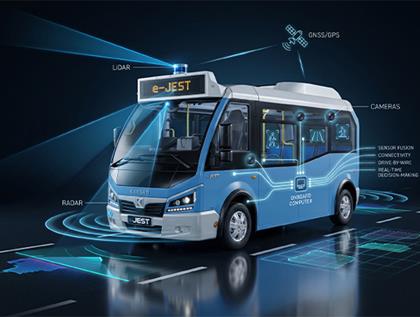
14 September 2026What Makes a Bus Truly Autonomous? The Sensors and Systems Behind Karsan's e-JEST
-
07 September 2026Measuring Sustainability in Public Transport: Which KPIs Matter Most?
-
28 August 2026Karsan × Toyota: Building the Hydrogen Bus of the Future

Electric Mobility Becomes Mainstream Amongst Private Transport Companies
For many years, the idea of electric mobility appeared to be strictly a municipal affair; it was mainly driven by public procurement and government initiatives to establish electric vehicle usage. However, this is rapidly changing. In Europe, private transportation companies are emerging as the leading force behind the electrification of transportation.
Examples of private transportation companies include Airport Shuttle Services, Hotel Transfer Services, Corporate Fleet Services, and Employee Transportation Services, all of which are transitioning to Battery Electric Vehicles (BEVs). The primary reasons for these transitions are not based on image, but rather economics. When measuring the total cost of ownership (TCO), electric buses can often provide private transportation companies with significant reductions in operating costs, reduced maintenance requirements, and improved driver experience and productivity.
Balancing Costs, Comfort and Compliance Requirements
In 2023, a well-known European airport shuttle service contacted Karsan with concerns regarding several issues related to their existing diesel-powered fleet. The company operates 24/7 in transporting travelers between airports, hotels and long-term parking areas. Due to increased fuel prices, maintenance intervals were decreasing, and replacement parts were increasing in cost. Additionally, new regulatory requirements imposed by the airport were reducing the maximum allowable emission levels and noise restrictions during nighttime operations. Lastly, the company's customers and hotel partners began expressing dissatisfaction with the noise and odors produced by the idling diesel engines.
The private transportation company required a fleet of vehicles that would allow them to meet the new regulatory requirements, reduce operating costs, and continue providing a high-quality, reliable transportation service.
Measuring the Business Case Through Total Cost of Ownership (TCO)
Instead of simply promoting products, Karsan began building a business case by analyzing the TCO of the diesel fleet versus the electric fleet. This included using real-world inputs such as route distances, driving habits, electricity pricing, maintenance frequency, and projected resale values.
The results were clear-cut: An electric fleet would cost approximately one-third less to operate than a diesel fleet over a five-year period. The savings resulting from lower energy costs would essentially repay the higher purchase price of the electric vehicles within four years. After accounting for additional benefits related to lower maintenance and tax credits, the business case for electric vehicles was virtually unbeatable.
Upon reviewing the TCO model, the management team quickly transitioned the discussion from "Can we afford to electrify?" to "How quickly can we begin?"
Transitioning to Electric Vehicles – Designed Around Operations
Replacing a fully operational fleet is not a trivial task, particularly for private transportation companies that cannot afford lost revenue due to downtime. Working together with Karsan's Engineering Department, the private transportation company developed a staged transition plan that would enable the electrification of the fleet without negatively impacting daily schedules.
During Stage One, ten Karsan e-ATAK electric buses were placed in service on designated routes that consistently traveled predictable daily distances of 150 to 220 kilometers. At the end of each day, the electric buses returned to the depot, where they could be charged overnight.
The depot itself underwent upgrades with a hybrid charging system consisting of slower AC chargers for nightly use and several DC fast chargers for mid-day topping-up. The smart load-management software integrated into the charging system ensured that peak demand was always met during off-peak hours, minimizing the cost of electricity purchased from the utility.
Karsan also provided a comprehensive training program for drivers and maintenance personnel, covering regenerative braking efficiency, battery-health monitoring and the use of telematics for predictive maintenance.
Within six months, the transition of the fleet to electric vehicles was completed without any scheduled cancellations.
Year One Results: Data and Customer Feedback That Speak Louder Than Engines
Twelve months after operation began, the effects of the transition were evident in both financial reports and customer feedback.
Compared to the previous diesel-powered fleet:
-
Operating cost per kilometer decreased by nearly two-thirds
-
Routine maintenance costs were reduced by nearly half
-
The new electric buses achieved an impressive 98% uptime
-
Noise levels decreased by roughly 40 dB, enabling nighttime operation without disturbing nearby hotels
Drivers reported significantly less fatigue due to smoother acceleration and quieter interiors. Passengers described the ride as cleaner, calmer, and "unbelievably peaceful" — a phrase later used in advertising.
By year-end, the company had eliminated the equivalent of over 300 tons of CO₂ emissions and recorded a 15% increase in customer satisfaction ratings, contributing directly to renewed contracts with hotel chains and travel agencies.
Lessons for Every Private Transportation Operator
Since then, the airport shuttle company’s transition has become a model for other private fleets. Four basic lessons emerged:
-
Begin with a Total Cost of Ownership (TCO) analysis rather than the sticker price.
-
Electrify the most suitable routes first — those with predictable daily distances and depot return.
-
Combine AC and DC charging for efficiency and flexibility.
-
Share sustainability achievements, as customers increasingly reward environmentally responsible operators.
Why Karsan Is the Preferred Partner
Private operators choose Karsan not only for vehicle quality but also for full-cycle support throughout the transition process.
Karsan’s electric portfolio — e-JEST, e-ATAK, e-ATA 12 and e-ATA 18 — is built for commercial reliability, operational flexibility, and compatibility. All models use OCPP-compliant smart-charging systems and modular battery designs that support range scalability.
Integrated telematics give operators real-time data on consumption, state of charge, and service needs, resulting in higher uptime, lower life cycle costs and easier fleet management.
The Bigger Picture: Economics and Sustainability Align
For private fleets, adopting electric vehicles is no longer about compliance — it's economics.
-
Lower energy costs
-
Lower maintenance costs
-
Better driver comfort and productivity
-
Higher customer satisfaction
-
Stronger sustainability credentials
Electric fleets have evolved from a regulatory checkbox into a competitive advantage.
The Takeaway
This example demonstrates that adopting electric vehicles does not require compromising performance or assuming unnecessary risk. With strategic planning and the right technology partner, private fleets can achieve lower costs, higher efficiencies and stronger customer loyalty — all delivered through quiet, zero-emission buses.