-
23 February 2023Karsan Hydrogen Fuel Cell Bus e-ATA Hydrogen
-
17 July 2024Small City Buses: The Eco-Friendly Choice for Urban Commutes
-
23 September 2024Different Bus Sizes in Urban Transportation
-
02 October 2024What is a Shuttle Bus? How is it Used in Urban Transportation?
-
21 September 2026What Is Transit-Oriented Development (TOD)?
-
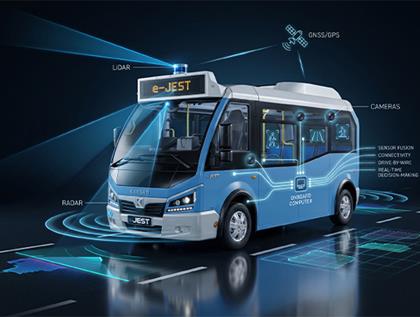
14 September 2026What Makes a Bus Truly Autonomous? The Sensors and Systems Behind Karsan's e-JEST
-
07 September 2026Measuring Sustainability in Public Transport: Which KPIs Matter Most?
-
28 August 2026Karsan × Toyota: Building the Hydrogen Bus of the Future

Why Size Matters: How Karsan’s “Scalable Range” (6m to 18m) Solves Every Urban Challenge
One size will never be suitable for all in public transportation. In Bologna, a six meter wide bus will never work for the narrow streets of this city as it would in the crowded corridors of Berlin. This is why Karsan developed what most producers missed out on: a completely scalable electric bus range, capable of adapting to every city's rhythm.
Karsan’s lineup has a fully scalable range, including the 6-meter e-JEST and the 18-meter articulated e-ATA. Karsan offers local authorities and operators a comprehensive tool set to make a transition to electrical networks -- efficient, flexible, and sustainable.
The "Scalable" Idea
The philosophy behind Karsan’s scalable range is simple. As cities evolve, mobility systems must evolve as well. A small coastal town has a much smaller transport footprint than a capital of 3 million commuters. Yet both need quiet, emission-free transport.
This is where scalability becomes essential. Rather than forcing cities into one electric bus model, Karsan’s range spans every segment -- from micro-transit to high-density BRT lines.
6m e-JEST: the agile urban mini-bus for inner neighborhood routes, old-town routes, and last-mile routes.
8m e-ATAK: the mid-size backbone of suburban and secondary routes.
10m, 12m, and 18m e-ATA family: full-scale city buses and articulated giants for the highest-capacity corridors.
It’s a modular method of fitting reality, rather than fitting the opposite.
Small Bus, Large Impact: The 6m e-JEST
Many cities faced a major issue when switching to electric fleets: space constraints. Narrow streets, alleys, and steep hills prevented large 12-meter buses from entering the area.
The e-JEST fills this void perfectly. Despite its compact size, it is fully electric and allows operators to navigate the tightest neighborhoods quietly and without emissions. The e-JEST transforms the smallest of streets into clean transport corridors.
With a 210 km operating range, regenerative braking, and BMW’s proven electric drivetrain, the e-JEST quickly became popular in Europe -- from Bologna to Lisbon. Many municipalities saw it as the first practical step toward full electrification.
The 8m Optimal Choice: Karsan e-ATAK
Large cities with limited infrastructure often require medium-sized buses to balance passenger volumes and route characteristics. The e-ATAK, at 8 meters, is the optimal solution.
Carrying up to 52 passengers and capable of 300+ km of continuous operation, it can recharge in under three hours. Combined with high comfort, excellent visibility, smooth acceleration, and silent travel, it is the preferred choice in cities such as Luxembourg, where e-ATAKs connect residential districts with major transport hubs.
Operators value the e-ATAK’s maneuverability and efficiency. Passengers love its comfort and silence. It is a relatively small bus, but it travels like a large one -- without the larger footprint.
Scale-up: The 10–18m e-ATA Family
As cities move from pilot projects to full electric networks, scalability becomes crucial. The e-ATA family is Karsan’s answer.
The family includes the 10m, 12m and 18m e-ATA models, offering solutions for dense city routes and high-capacity BRT corridors. The 18m articulated e-ATA can carry up to 135 passengers with zero tailpipe emissions and supports both recharging and refueling configurations, depending on the drivetrain version.
Every model in the e-ATA family shares Karsan’s DNA: lightweight construction, modular battery systems, and optimized energy consumption -- all lowering operating costs for users.
The common platform logic also simplifies maintenance and training regardless of fleet size. Whether electrifying a small town or a metropolis, the e-ATA family adapts seamlessly.
Meeting City Diversity with Intelligent Design
European cities vary profoundly. One block might have a medieval alley, while the next is a modern boulevard. Karsan’s “one family, multiple sizes” approach allows planners to serve all contexts.
-
The e-JEST handles last-mile travel, connecting homes, hospitals and transit hubs.
-
The e-ATAK bridges suburban zones.
-
The e-ATA family carries the heaviest loads in high-demand corridors.
All under the same zero-emission infrastructure.
For operators, this means unified charging, software, and service ecosystems. For passengers, it means quiet rides, cleaner air, and broader accessibility.
Built for Tomorrow — Not Just Today
Karsan’s e-ATA family is designed for future mobility ecosystems. All models support intelligent fleet management, optimized energy usage, and hydrogen-based upgrades as city networks evolve.
The modular battery architecture enables future range extensions without replacing the entire vehicle. Such flexibility transforms a fleet purchase into a long-term investment in urban quality of life.
Frequently Asked Questions
• What does "scalable range" mean for cities?
It means cities can choose from multiple bus sizes to match route types and still manage a unified electric network.
• How does Karsan’s e-JEST differ from other small e-buses?
It is compact yet fully electric, offering premium comfort, long range, and the ability to maneuver in historic districts.
• Which Karsan bus suits high-density corridors?
The 18-meter articulated e-ATA is built for the highest-demand corridors and BRT systems.
• Can operators mix different sizes in a single fleet?
Yes. All Karsan electric buses share compatible technology and service platforms, making mixed fleets easy to manage.
From six to eighteen meters, Karsan demonstrates that size is not a limitation — it is a strategy.
Since the future of mobility is not one size fits all — it is the correct size for every street.