-
23 February 2023Karsan Hydrogen Fuel Cell Bus e-ATA Hydrogen
-
17 July 2024Small City Buses: The Eco-Friendly Choice for Urban Commutes
-
23 September 2024Different Bus Sizes in Urban Transportation
-
02 October 2024What is a Shuttle Bus? How is it Used in Urban Transportation?
-
21 September 2026What Is Transit-Oriented Development (TOD)?
-
14 September 2026What Makes a Bus Truly Autonomous? The Sensors and Systems Behind Karsan's e-JEST
-
07 September 2026Measuring Sustainability in Public Transport: Which KPIs Matter Most?
-
28 August 2026Karsan × Toyota: Building the Hydrogen Bus of the Future
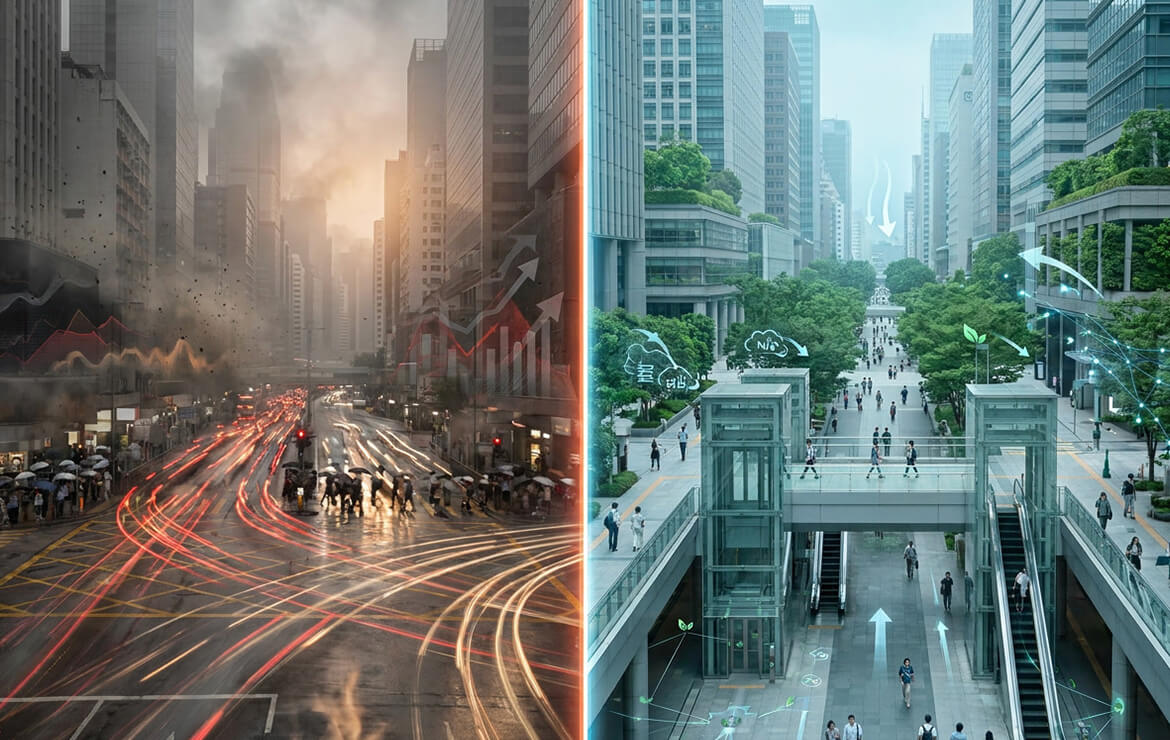
Urban gridlock is widely recognized as a major drain on economic productivity and driver sanity, yet its most destructive consequence remains largely invisible. When thousands of vehicles sit trapped in gridlock, the resulting traffic congestion environmental impact causes severe degradation to public health and urban ecosystems. Metropolitan road networks operating beyond capacity do not simply delay commuters; they function as concentrated, stationary sources of high-volume greenhouse gas emissions and particulate matter.
Resolving this environmental crisis requires a structural shift away from private vehicle dependency. Expanding traditional internal combustion transport networks is no longer a viable remedy, as it frequently induces further driving demand. Instead, municipal planning authorities must implement zero emission bus fleets designed to absorb private passenger volumes into streamlined, high-occupancy corridors. Transitioning to a highly efficient electric bus network allows modern municipalities to directly combat urban air quality degradation while restoring baseline energy efficiency to public road networks.
The Mechanics of Gridlock: Idling, Emissions, and Air Quality
The correlation between traffic congestion air pollution and environmental damage is rooted in the operational physics of conventional internal combustion engines (ICE). Vehicles engineered for highway efficiency experience a catastrophic drop in fuel economy when subjected to stop-and-go metropolitan traffic. During peak gridlock, engines operate continuously in low-gear acceleration cycles and extended idling states, both of which represent the least efficient bands of thermal performance.
This continuous friction drastically increases the volume of localized tailpipe pollutants. Prolonged vehicle idling leads to incomplete fuel combustion, which significantly elevates ambient concentrations of carbon dioxide, volatile organic compounds, and fine particulate matter. Because these emissions are released at ground level inside dense architectural corridors, they become trapped, forming hazardous localized smog layers. This concentrated pollution poses severe respiratory risks for urban populations and actively accelerates regional climate degradation.
Decarbonizing Commutes: The Impact of Scale and Shared Mobility
The most direct mechanism to reduce urban traffic emissions is replacing low-occupancy private trips with high-capacity electric city bus services. A standard private commuter vehicle moving through a dense city center represents a massive expenditure of energy per individual passenger mile. By shifting these fragmented passenger curves into organized shared transit networks, cities achieve an immediate reduction in total on-road vehicle volume, lowering both structural gridlock and aggregate tailpipe output.
To maximize the ecological benefits of this consolidation, transit agencies must ensure that smaller feeder lines and low-density suburban routes remain deeply integrated with main urban corridors. Deploying compact electric bus platforms along these auxiliary lines ensures that shared transit remains accessible without running oversized, half-empty vehicles through narrow streets. Municipalities looking to improve last-mile connectivity and reduce reliance on private vehicles can explore how small city buses support more flexible and efficient urban transport networks in Small City Buses: The Eco-Friendly Choice for Urban Commutes.
The Zero-Emission Blueprint: Electrified Public Transit
While consolidating passenger trips into shared fleets significantly relieves physical road congestion, true environmental neutrality requires a complete transformation of the vehicle powertrain. Substituting conventional diesel-powered transit assets with advanced electric bus platforms removes tailpipe pollutants entirely from dense metropolitan centers. This systemic transition enables municipalities to separate urban population growth from escalating local emission rates.
Electric drivetrains offer an immense operational advantage within high-congestion zones due to their inherent mechanical efficiency in stop-and-start traffic. Unlike conventional internal combustion setups that waste massive thermal energy while idling, electric motors draw zero battery power when a vehicle is at a complete standstill. Furthermore, during frequent deceleration cycles, advanced regenerative braking systems capture kinetic energy and feed it back into the high-voltage onboard battery pack, significantly lowering overall depot charging pressures.
Integrating Clean Infrastructure with Modern Urban Frameworks
Reversing the environmental damage caused by urban gridlock requires a comprehensive approach that extends far beyond the role of an electric bus manufacturer. True sustainable urban mobility is achieved only when clean vehicle deployment is paired with smart digital distribution networks and egalitarian infrastructure planning. This dual approach ensures that clean transportation options are both structurally efficient and accessible to all segments of the population.
-
Digital Transit Syncing: Implementing intelligent routing systems allows transit networks to dynamically adjust fleet distribution based on real-time traffic anomalies. Planners can study how open digital frameworks enhance fleet utilization by examining the role of Mobility as a Service (MaaS) in modern smart city ecosystems.
-
Egalitarian Urban Access: Transitioning to clean transportation models provides a vital public service by clearing localized emissions out of historically high-density neighborhoods. To analyze how zero-emission infrastructure supports balanced urban development, planners can reference the analysis on Social Sustainability: How Green Transport Creates Equal Cities.
Adaptive Electrification: Tailoring Vehicle Dimensions to Urban Needs
A major challenge for modern transit operators trying to deploy sustainable transportation solutions is navigating the highly diverse spatial layouts of historic and modern city centers. A uniform fleet-sizing strategy cannot achieve optimal efficiency across a multi-layered municipal map. Deploying standard heavy-duty platforms along tight, winding historical lanes leads to immediate physical bottlenecks, while utilizing under-sized shuttles along major arterial commuter routes causes terminal overcrowding.
Karsan resolves these structural challenges by delivering a comprehensive, factory-built electric bus lineup tailored to fit every tier of the modern urban transit matrix:
-
Agile Microtransit Feeders: The 6-meter e-JEST electric minibus platform is specifically engineered to navigate narrow neighborhood grids, historical tourism zones, and steep residential avenues, serving as an efficient feeder mechanism for high-capacity transit hubs.
-
Versatile Mid-Sized Shuttles: The 8-meter e-ATAK electric city bus model provides an optimal balance of high passenger capacity and compact agility, making it the ideal choice for mid-density urban loops and variable off-peak transit schedules.
-
Heavy-Duty Commuter Platforms: The robust e-ATA electric bus series, spanning from 10 to 18 meters, is purpose-built to handle dense passenger surges across major metropolitan trunk routes, moving large volumes of commuters with zero tailpipe emissions.
Conclusion: Building the Livable Cities of Tomorrow
The true environmental cost of traffic congestion can no longer be ignored as a minor inconvenience. Mitigating the severe impacts of vehicle idling, reducing urban carbon footprints, and restoring baseline air quality requires an immediate, systemic transition toward electrified transit infrastructures. By replacing fragmented, high-emission private trips with a coordinated, right-sized zero emission bus fleet, modern cities can successfully transform congested roadways into clean, efficient, and highly liveable urban spaces.
To evaluate how a scalable, fully electric bus portfolio can optimize your municipal route productivity and integrate seamlessly into high-density charging grids, fleet managers can explore the complete technical specifications and modular battery options of Karsan’s Electric Public Transport Solutions.