-
23 February 2023Karsan Hydrogen Fuel Cell Bus e-ATA Hydrogen
-
17 July 2024Small City Buses: The Eco-Friendly Choice for Urban Commutes
-
23 September 2024Different Bus Sizes in Urban Transportation
-
02 October 2024What is a Shuttle Bus? How is it Used in Urban Transportation?
-
21 September 2026What Is Transit-Oriented Development (TOD)?
-
14 September 2026What Makes a Bus Truly Autonomous? The Sensors and Systems Behind Karsan's e-JEST
-
07 September 2026Measuring Sustainability in Public Transport: Which KPIs Matter Most?
-
28 August 2026Karsan × Toyota: Building the Hydrogen Bus of the Future
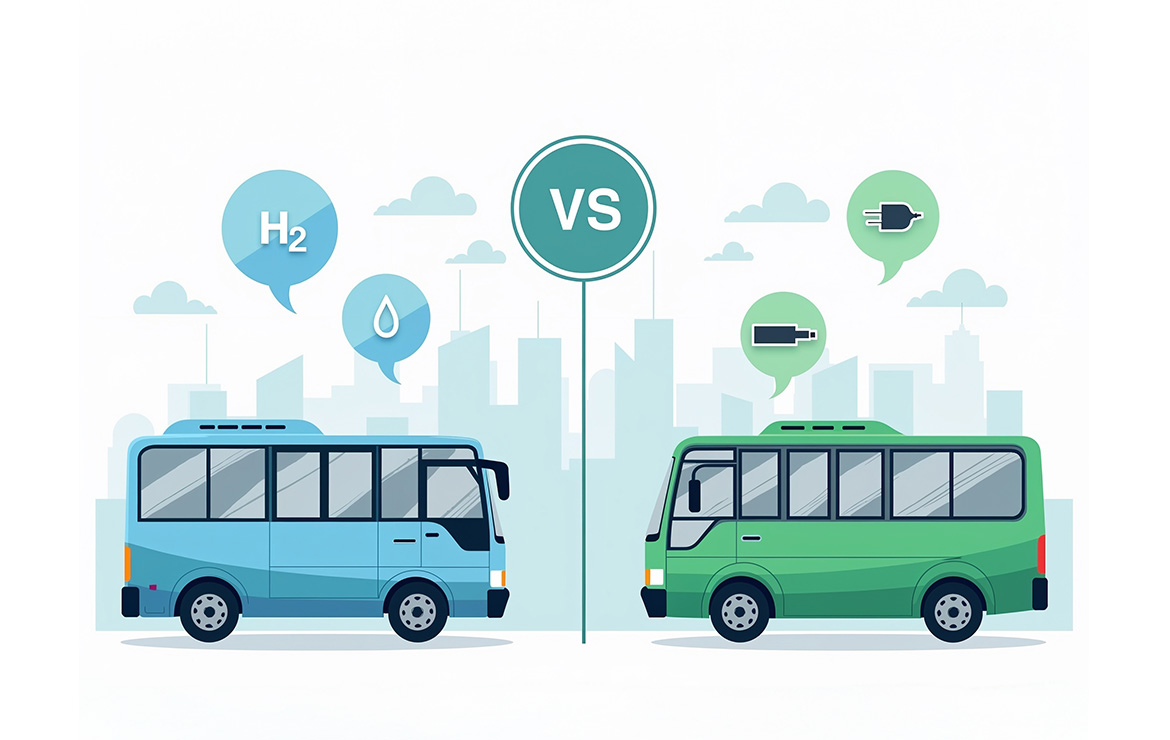
Electric vs Hydrogen Buses: Which Is Better for City Transit?
Cities across the world are at the forefront of the green mobility revolution. As urban populations rise — with over 80% of EU citizens expected to live in cities by 2050 — efficient, low-impact transportation is more critical than ever. Governments and transit agencies are under pressure to cut greenhouse gas (GHG) emissions, fight congestion, and improve air quality.
One of the most important decisions they face is choosing between battery-electric buses (BEBs) and hydrogen fuel cell electric buses (FCEBs). Both technologies are clean and quiet, but which one is better for city transit? The answer is nuanced.
Why This Debate Matters
-
Transport-related emissions in the EU are projected to increase until 2025 if no additional measures are taken. Even with current policies, transport emissions in 2030 would still be 9% above 1990 levels.
-
With climate neutrality targeted by 2050 and at least 55% emission cuts by 2030, decarbonizing public transport is non-negotiable.
-
Local public transport (LPT) has a key role: reducing private car dependence, cutting emissions, and supporting EU initiatives like Climate Neutral and Smart Cities.
Battery-Electric Buses (BEBs)
How they work: Powered by rechargeable batteries charged via the grid.
Advantages:
-
Zero tailpipe emissions
-
High efficiency (85–90%)
-
Lower operating costs and maintenance compared to diesel or hydrogen
-
Supported by fast-growing charging infrastructure
-
Falling battery costs and improving range
Challenges:
-
Range limited (160–200 miles per charge) unless batteries are very large (which adds weight and reduces capacity)
-
Long charging times (1–8 hours depending on charging mode)
-
Require strong grid capacity and investment in charging infrastructure
-
Cold weather reduces battery range significantly
Hydrogen Fuel Cell Buses (FCEBs)
How they work: Generate electricity onboard via a fuel cell combining hydrogen with oxygen, emitting only water vapor.
Advantages:
-
Long range (up to ~350 miles)
-
Fast refueling (8–15 minutes, similar to diesel)
-
Lighter than BEBs at equivalent ranges, reducing road wear
-
Flexible for longer and more demanding routes
-
Can store surplus renewable energy as hydrogen
Challenges:
-
Lower efficiency (60–70%) due to conversion losses
-
High fuel costs — currently $9–12/kg for green hydrogen vs $2/kg for gray hydrogen
-
Infrastructure gaps: very few hydrogen refueling stations today
-
Environmental trade-offs: most hydrogen today is “gray,” producing more CO₂ than natural gas combustion
-
Safety concerns with high-pressure storage and cryogenic handling
Efficiency and Emissions
-
Energy efficiency: BEBs clearly win, using electricity directly from the grid with minimal losses.
-
Emissions:
-
BEBs emit less CO₂ overall, especially in countries with clean power grids.
-
Gray hydrogen buses can produce twice the emissions of BEBs.
-
Green hydrogen could outperform BEBs in the long run, but production remains expensive and limited.
-
Cost Comparison
-
BEBs: Lower operational costs per mile ($0.27–$0.45). Infrastructure investment (charging hubs, grid upgrades) is significant but scalable.
-
FCEBs: Higher operational costs ($1.00–$1.80 per mile depending on hydrogen source). Infrastructure costs are high upfront, but potentially cheaper to scale for large fleets.
Case Study: Brescia Mobilità (Italy)
The city of Brescia offers a real-world look at decision-making:
-
Historically converted its fleet to 100% CNG by 2018.
-
With EU recovery funds, it is now investing in zero-emission buses (at least 13) and related infrastructure.
-
A feasibility study compared three options: BEBs, FCEBs, and continuing with CNG.
-
Evaluation criteria included CAPEX, OPEX, TCO, and TCRO across timelines (2022, 2025, 2030).
-
Findings: BEBs excel in cost-efficiency, while FCEBs show advantages for long-range operations but suffer from higher costs and slower technological maturity.
Case Study: Santa Cruz Metro (USA)
In 2024, Santa Cruz Metro approved the purchase of 57 hydrogen buses — the largest order in the U.S.
-
Why hydrogen? Long, hilly routes, 350-mile range, and 15-minute refueling vs 8-hour battery charging.
-
Risks: Currently no green hydrogen supply; reliant on gray hydrogen, which has higher emissions than natural gas. Fuel costs could overwhelm the agency’s budget if prices don’t drop.
-
The bet: California’s $1.2B federal + $2B state-funded ARCHES hydrogen hub will drive down costs and scale green hydrogen production by 2030.
-
Critics: Experts argue hydrogen is less efficient than batteries and too dependent on uncertain fuel supply chains.
Future Outlook
-
Europe: EU policies strongly favor BEBs, with France, Germany, and Spain committing to 100% zero-emission bus procurement. Registrations of electric buses already reached 6% in 2021 and are accelerating.
-
U.S.: A mixed picture — some agencies (San Francisco Muni, Marin Transit) go battery-only, others (AC Transit, Santa Cruz Metro) bet big on hydrogen.
-
Global: Emerging economies (Vietnam, Thailand, Brazil) are rapidly adopting BEBs due to lower costs and quicker deployment. Hydrogen remains niche, focused on specific long-haul or heavy-duty applications.
Which Is Better for City Transit?
There’s no universal answer. Instead, the choice depends on local context:
-
Choose Battery-Electric Buses if…
-
You prioritize efficiency and cost savings.
-
Routes are shorter and grid capacity is strong.
-
You want faster adoption and proven technology.
-
-
Choose Hydrogen Fuel Cell Buses if…
-
You need longer ranges and quick refueling.
-
Grid capacity is limited or upgrading is costly.
-
You can secure affordable green hydrogen supply.
-
What’s clear is that all-electric solutions — whether battery or hydrogen — are the future of city transit. BEBs are today’s frontrunner, while hydrogen may carve a role in specific high-demand niches once green hydrogen becomes cost-competitive.
In the end, the real winner is zero-emission public transport — essential for cleaner air, climate action, and healthier urban living.