-
23 February 2023Karsan Hydrogen Fuel Cell Bus e-ATA Hydrogen
-
17 July 2024Small City Buses: The Eco-Friendly Choice for Urban Commutes
-
23 September 2024Different Bus Sizes in Urban Transportation
-
02 October 2024What is a Shuttle Bus? How is it Used in Urban Transportation?
-
21 September 2026What Is Transit-Oriented Development (TOD)?
-
14 September 2026What Makes a Bus Truly Autonomous? The Sensors and Systems Behind Karsan's e-JEST
-
07 September 2026Measuring Sustainability in Public Transport: Which KPIs Matter Most?
-
28 August 2026Karsan × Toyota: Building the Hydrogen Bus of the Future
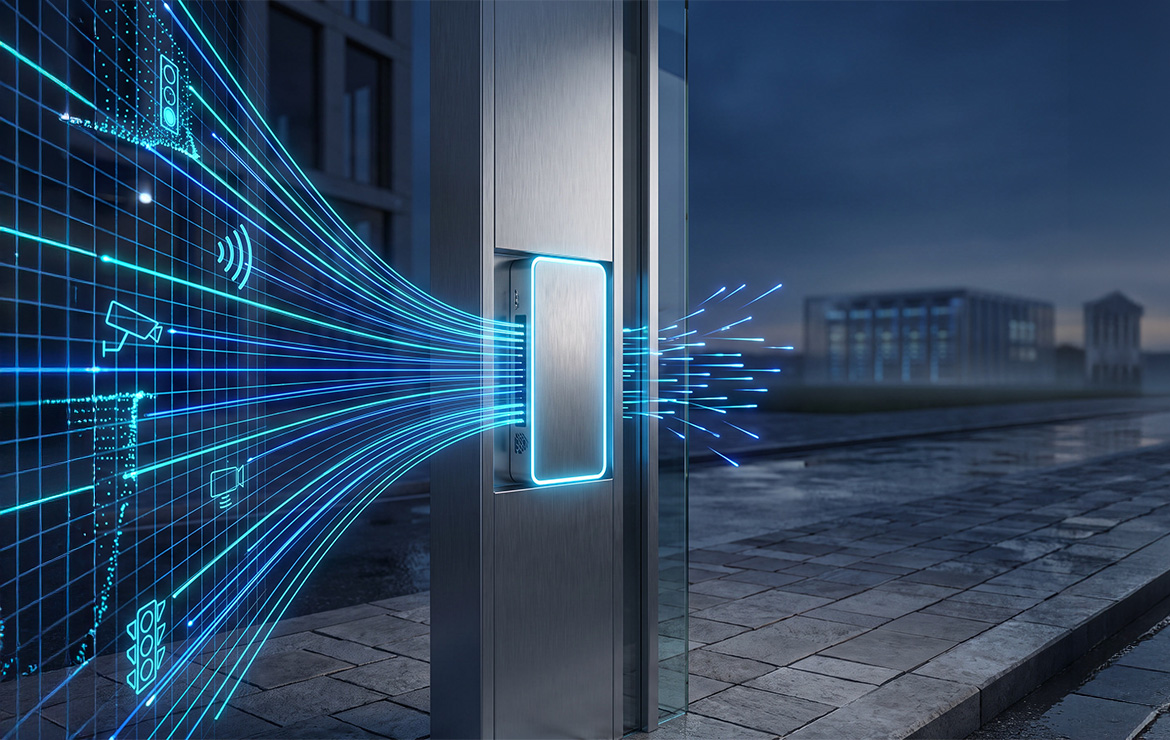
Modern urban transit is undergoing a profound technological shift. As cities deploy drivrless transit networks to improve route efficiency and passenger safety, discussions often center on vehicle automation levels or sensor arrays. However, the true technical foundation of safe autonomous operation lies in data architecture specifically, where and how fast critical operational data is processed.
While cloud computing powers back-end scheduling, predictive maintenance, and overall fleet optimization, an autonomous bus cannot rely solely on off-site servers to navigate live urban environments. In high-density transit corridors, processing operational data locally on the vehicle known as edge computing is not merely an efficiency feature; it is an absolute safety requirement.
Why the Cloud Is Not Enough: The Latency Imperative
Cloud infrastructure excels at handling massive volumes of aggregated data across distributed networks. However, cloud-bound data transmission introduces an unavoidable physical constraint: latency. Sending raw sensor telemetry to remote data centers, processing it, and transmitting action commands back to a vehicle takes anywhere from tens to hundreds of milliseconds.
According to autonomous driving safety metrics established in IEEE and SAE transport engineering literature, the complete perception-to-actuation processing loop must execute within a strict sub-200-millisecond threshold to ensure collision avoidance. From a vehicle kinematics perspective, latency directly translates to unguided travel distance: a vehicle traveling at 50 km/h covers approximately 13.9 meters every second. A cloud transmission latency delay of even 200 milliseconds means the vehicle travels nearly 3 meters before any deceleration or steering command can be executed onboard. In dense municipal corridors where sudden obstacles require instant reaction, this delay introduces critical safety hazards that only onboard edge processing can eliminate.
Furthermore, cloud reliance creates vulnerability to network blackouts, signal attenuation in urban canyons, or cellular congestion. A true zero emission bus operating at Level 4 autonomy must maintain absolute operational sovereignty, ensuring that critical navigation systems remain fully functional even when external wireless connectivity is degraded or lost.
Decoupling Onboard Intelligence: What Is Edge Computing?
Edge computing resolves the latency bottleneck by moving high-performance computational processing directly onto the vehicle. Instead of transmitting raw sensor telemetry across cellular networks to distant servers, an edge computing architecture processes, filters, and analyzes data at the local source onboard the bus itself.
By hosting high-throughput graphics processing units (GPUs) and specialized neural network accelerators within the vehicle's hardware architecture, an autonomous bus executes complex algorithmic decisions locally. The cloud remains vital for non-time-sensitive operations, such as historical route analytics and firmware updates, while onboard edge node architecture retains complete control over real-time motion planning, collision avoidance, and trajectory adjustments.
Split-Second Decisions: Millisecond Processing in Action
To understand why edge processing speed matters, consider the continuous sensory feedback loop required during a standard municipal route. As a driverless vehicle navigates a busy intersection, its software architecture executes four sequential tasks in real time:
-
Data Ingestion: Instantaneously capturing multi-directional spatial data from integrated hardware arrays.
-
Object Perception & Classification: Identifying dynamic actors across the roadway, distinguishing between pedestrians, cyclists, moving vehicles, and static obstacles.
-
Trajectory Prediction: Calculating the immediate vectors and speed profiles of surrounding objects to predict potential path intersections.
-
Actuation & Motion Control: Directly triggering drive-by-wire braking, steering, or acceleration systems.
Onboard edge computing executes this complete perception-to-actuation loop within mere milliseconds. This near-instantaneous processing speed provides the split-second margin necessary to navigate complex urban friction points safely and smoothly.
The Sensor Data Flood: Processing Millions of Points Per Second
The necessity of edge computing becomes even clearer when evaluating the immense volume of data generated by modern Level 4 autonomous platforms. To perceive its environment with absolute spatial redundancy, a Level 4 autonomous bus relies on a dense array of cameras, radar units, and LiDAR systems.
The computational load created by these primary sensor streams is massive:
-
LiDAR Systems: LiDAR systems can generate more than one million data points per second, depending on the sensor model, creating detailed 3D point-cloud maps of surrounding space.
-
Optical Camera Arrays: High-definition vision cameras stream multiple gigabytes of uncompressed visual data every minute to track lane markings, traffic signals, and depth perception.
-
Radar Infrastructure: Long-range and short-range radar arrays continually measure object velocity and distance under adverse weather conditions.
Transmitting this raw, uncompressed sensor stream to the cloud in real time would saturate local cellular bandwidth and require prohibitive network overhead. Edge architecture solves this data flood by performing immediate onboard data fusion, instantly transforming raw point-cloud layers into actionable spatial maps locally.
Architectural Approach: Karsan’s Real-World Edge Sovereignty
Executing reliable, high-speed edge processing requires a vehicle platform specifically engineered for automated hardware integration. As a leading electric bus manufacturer, Karsan designs its zero-emission platforms with the dedicated space, thermal management, and power distribution needed to sustain high-density onboard computing networks.
In deployments such as the Autonomous e-ATAK, Karsan integrates Level 4 autonomous software directly into the vehicle's drive-by-wire architecture. Rather than retrofitting legacy platforms, Karsan configures its vehicle ecosystem to support high-throughput sensor fusion and localized edge processing. Fleet managers evaluating real-time decision-making in Level 4 autonomous buses can explore the technical framework detailing How Level 4 Autonomous Buses Work: The Technology Behind Driverless Transit to analyze how onboard perception arrays and drive-by-wire controls deliver split-second operational safety.
Whether operating a mid-sized transit vehicle or a compact electric bus, Karsan's architectural approach ensures that sensor data is processed onboard instantly. This high-capacity hardware structure allows municipal operators to deploy a driverless electric bus company fleet with total confidence in system responsiveness.
Offline Resilience: Maintaining Absolute Safety Without Connectivity
A core benchmark of Level 4 autonomy is operational continuity under network failure. In real-world urban transit, vehicles regularly pass through cellular dead zones, underground tunnels, high-density building shadows, or regions experiencing severe network congestion.
If an autonomous bus relied on external cloud processing, entering a connectivity shadow would force the vehicle to trigger an immediate emergency stop or disengage autonomous mode. Edge computing eliminates this operational vulnerability. Because all safety-critical perception models, localization algorithms, and actuation controls run on internal processors, an autonomous bus operates with complete offline resilience. The vehicle seamlessly executes its scheduled route block, stops safely at designated station perimeters, and navigates complex traffic patterns regardless of external signal availability.
Future Perspective: The 5G and Edge Hybrid Ecosystem
While edge computing handles instantaneous onboard safety decisions, the future of urban transit relies on a powerful hybrid model combining onboard edge intelligence with ultra-reliable low latency 5G networks.
In this evolving ecosystem, edge computing remains responsible for immediate electric bus control and obstacle avoidance, while 5G connectivity enables high-level collaborative intelligence:
-
V2X (Vehicle-to-Everything) Communication: Edge-processed data is shared between neighboring vehicles and smart traffic signals to optimize intersection throughput and prevent regional gridlock.
-
Remote Fleet Teleoperation: High-bandwidth, low-latency streams allow centralized control centers to monitor vehicle health and provide high-level route guidance during unusual road closures.
-
Continuous Edge-to-Cloud Learning: Edge processors record edge-case sensory scenarios locally during daily shifts. During overnight depot charging, these data snippets are uploaded to the cloud to retrain global machine learning models, continuously improving fleet-wide performance.
Conclusion: Speed and Onboard Processing as the Core Safety Foundation
As municipal transit agencies transition toward autonomous zero emission bus networks, evaluating vehicle capabilities must extend beyond traditional physical metrics. The true measure of a driverless vehicle's safety and operational viability lies in its computational responsiveness.
By placing high-performance edge computing directly onboard, modern autonomous platforms eliminate cloud latency delays, process millions of sensor data points per second locally, and maintain uninterrupted operational safety during network disconnects. This data-first architecture ensures that autonomous public transport delivers the speed, reliability, and split-second precision required to redefine the future of urban mobility.
To discover how a field-proven electric bus company delivers scalable, Level 4 driverless solutions engineered for high-density municipal grids, transit operators can examine the full technical capabilities and modular options available across Karsan’s Autonomous Public Transport Solutions.